Top 10 Types of Double Wall Heat Exchangers?

Time:2026-10-09 Author:Liam
0%

Choosing among the Top 10 Types of Double Wall Heat Exchangers requires more than comparing catalog dimensions. Each design manages heat transfer, pressure, maintenance, and leakage risk differently. A Double Wall Heat Exchanger uses two separating walls between fluids, creating an additional barrier when one wall develops damage. This feature matters in potable water, chemical processing, refrigeration, and other safety-sensitive systems.

The most common options include double-wall shell-and-tube, double-wall plate, double-pipe, coiled, spiral, brazed, gasketed, welded, jacketed, and compact designs. Their performance changes with fluid viscosity, temperature difference, pressure, fouling tendency, and available installation space. For example, a plate model may provide strong heat transfer in a narrow footprint, while a shell-and-tube unit may offer easier tube-side inspection. A coiled exchanger can fit awkward equipment layouts, but cleaning may become difficult. Small details matter.

So does monitoring.

Reliable selection starts with verified operating data and clear failure consequences. Engineers should review materials, weld quality, gasket compatibility, inspection access, thermal expansion, and leak-detection arrangements. Recognized design practices and supplier test records also deserve careful review. A familiar model is not automatically the safest choice. That shortcut can fail.

This guide compares ten practical exchanger types through those criteria. It considers where each design performs well, where maintenance becomes costly, and which applications may expose hidden weaknesses. The comparison is not absolute. Actual results depend on water chemistry, operating discipline, and installation quality. Even a well-rated exchanger can underperform when fouling is ignored or flow is poorly balanced. Expect useful direction, not a universal answer.
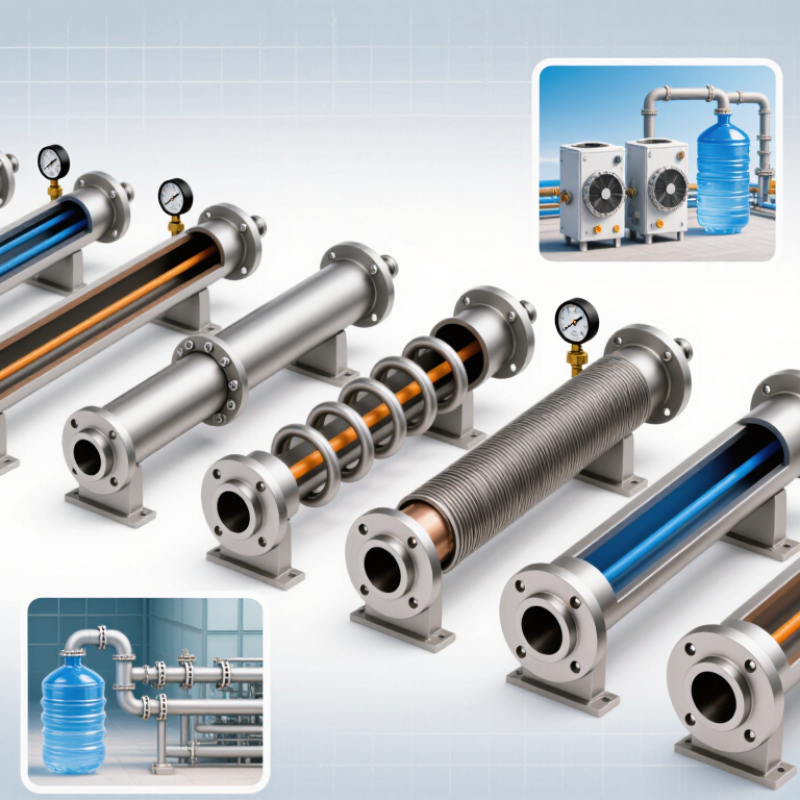
Top 10 Types of Double Wall Heat Exchangers?

Define double-wall heat exchangers: two barriers plus a leak-detection gap

Top 10 Types of Double Wall Heat Exchangers?

A double-wall heat exchanger uses two separate barriers between the process fluids. A small gap remains between these walls. This gap supports leak detection before fluid mixing occurs. In practical installations, the gap may connect to a drain, sensor, pressure gauge, or monitoring chamber. If the inner wall fails, escaping fluid enters the gap and creates a visible or measurable warning. This design is valuable where cross-contamination could damage equipment, products, or public systems. Common types include double-wall shell-and-tube, double-wall plate, double-wall coaxial, double-wall tube-in-tube, double-wall brazed plate, gasketed plate, welded plate, spiral, air-cooled, and sanitary heat exchangers.

The two barriers need suitable materials, spacing, and inspection access. A narrow gap saves space but may restrict detection. A larger gap improves visibility but can reduce heat-transfer efficiency. Operators should check pressure ratings, thermal expansion, cleaning methods, and sensor response time. I have found that installation details often matter more than the exchanger label. A poorly positioned drain can hide a small leak. That is an easy mistake to miss. Detection does not repair the failed wall. It only provides time to isolate the equipment safely.

Tips: Specify the leak-detection method before ordering. Test alarms during commissioning. Record normal gap pressure and temperature. Inspect both barriers during scheduled maintenance. Do not assume a “double wall” always means continuous protection; some designs use segmented or partially separated barriers. Verify the construction drawings and test certificates.

Classify plate designs: gasketed, welded, and brazed types up to 30 bar

Top 10 Types of Double Wall Heat Exchangers

Double wall heat exchangers use two separating plates to reduce cross-contamination risk. Their designs mainly fall into gasketed, welded, and brazed categories. Common configurations include single-pass, multi-pass, wide-gap, sanitary, removable-plate, laser-welded, fully welded, cassette, brazed, and hybrid designs.

Gasketed double wall units use elastomer seals around each plate. They suit maintenance-heavy systems because technicians can open and clean them quickly. Typical ratings may reach 10–25 bar, while some engineered models approach 30 bar. Temperature, gasket material, and bolt loading still control the real limit. A small seal defect can create a visible leak path between plates. That feature matters in potable water, heating circuits, and chemical service.

Welded designs remove most gasket concerns. Laser-welded cassettes can provide strong containment and compact construction. Fully welded plates handle demanding temperatures and pressure cycles, but internal cleaning becomes harder. Brazed units join plates permanently with a filler metal, creating low resistance and compact dimensions. They can reach 30 bar in suitable applications, yet they offer limited repair options. Pressure ratings are not universal. Check the nameplate, material compatibility, test standard, and cycling conditions. In practice, designers sometimes overvalue pressure alone. A 30-bar rating does not guarantee safe performance with corrosive fluid, vibration, or repeated thermal shocks. The best choice depends on leak detection, service access, and the consequences of fluid mixing.

Classify tubular designs: double-pipe, coaxial, and tube-in-tube units

Top 10 Types of Double Wall Heat Exchangers?

Double wall heat exchangers are not one uniform design. In tubular classifications, double-pipe units use one process pipe inside a larger pipe. One fluid travels through the inner tube, while the second moves through the annulus. Coaxial units follow the same concentric principle, but usually use purpose-built inner and outer tubes. Tube-in-tube units may describe welded, removable, or sanitary versions of this arrangement. The terminology overlaps. That causes procurement mistakes.

A practical selection review checks heat duty, pressure drop, fouling, cleaning access, and leak detection. Pressure drop matters. For a small flow, coaxial geometry can maintain good velocity and reduce stagnant zones. For larger duties, multiple double-pipe modules may be installed in parallel. This improves flexibility, but increases fittings and inspection points.

U.S. Department of Energy research estimates that 20–50% of industrial energy input can leave as waste heat, making recovery performance commercially important (DOE, Waste Heat Recovery: Technology and Opportunities in U.S. Industry).

Double-wall separation also deserves careful attention. Two metal walls can provide secondary containment, but they do not automatically guarantee zero leakage. Materials, weld quality, thermal expansion, and monitoring design remain critical. MarketsandMarkets valued the global heat exchanger market at about USD 16.4 billion in 2023 and projects continued growth through 2028. That forecast supports investment, not every design choice. Fit is everything. Field conditions often expose assumptions that laboratory calculations miss.

Classify advanced designs: shell-and-tube, spiral, finned-tube, and air-gap types

Top 10 Types of Double Wall Heat Exchangers?

Double-wall heat exchangers separate fluids with two independent barriers. The main families include double-pipe, shell-and-tube, spiral, plate, plate-fin, finned-tube, microchannel, bayonet, jacketed, and air-gap designs. Each design manages heat transfer, leakage risk, pressure drop, and cleaning differently.

Shell-and-tube units remain practical for high pressure and large flow rates. Spiral exchangers use compact passages and can resist fouling in some liquid services. Finned-tube and air-cooled designs improve surface area when air replaces water. Plate and plate-fin types offer strong thermal performance in limited spaces, although gasket selection needs careful review. Microchannel units reduce volume, but blockage can become serious. Bayonet and jacketed designs suit tanks, cryogenic duties, and controlled heating. Air-gap construction creates a visible space between walls, helping operators detect cross-contamination early.

The U.S. Department of Energy’s Industrial Decarbonization Roadmap reports that process heating represents about 51% of industrial energy use. Better exchanger recovery can therefore influence both operating cost and emissions. The International Energy Agency’s Energy Efficiency 2023 report also identifies industry as roughly 37% of global final energy demand. These figures support tighter thermal integration.

Still, no design wins everywhere. Field inspections often reveal neglected drains, poor venting, or fouled passages. Spiral geometry may look ideal on paper. It can disappoint when maintenance access is limited. Air-gap monitoring also needs disciplined inspection. The best selection combines duty data, failure consequences, cleaning practice, and verified test results.

Compare all 10 types using TEMA, ASME VIII, and EN 13445 criteria

Top 10 Types of Double Wall Heat Exchangers: Comparing TEMA, ASME VIII, and EN 13445

The ten common designs are double-wall shell-and-tube, double-tube-sheet shell-and-tube, double-wall tube bundles, double-pipe, tube-in-tube, coaxial, double-wall plate-and-frame, welded double-wall plate, spiral double-wall, and double-wall coil exchangers. TEMA mainly evaluates shell, tube, baffle, vibration, and leakage-control details. It is strongest for shell-and-tube construction. However, it does not classify every double-wall design equally.

ASME VIII treats the pressure boundary as the central concern. It checks allowable stress, thickness, reinforcement, weld efficiency, pressure testing, and fatigue where necessary. Double-tube-sheet and shell-and-tube units usually need the most detailed mechanical review. Double-pipe, coaxial, and coil designs can be simpler, but their closures still require careful calculations. A hidden weak point often appears at the tube-to-sheet joint.

EN 13445 adds robust rules for unfired pressure vessels, including materials, forming, welding, inspection, and design-by-analysis. Its fatigue assessment can expose repeated thermal cycling in plate, spiral, and compact units. TEMA practice may guide construction, while ASME VIII or EN 13445 may govern legal conformity. These standards are not interchangeable. Engineers should verify which code applies to the installation, fluid, pressure, and jurisdiction. In real projects, the double-wall gap also needs monitoring. Otherwise, a leak barrier may exist on paper only. That deserves more attention.

Top 10 Types of Double-Wall Heat Exchangers — Comparison Using TEMA, ASME VIII, and EN 13445 Criteria
No. Double-Wall Configuration Construction and Leak-Detection Principle Typical Relative Pressure Capability Typical Thermal and Maintenance Characteristics TEMA Assessment ASME VIII Assessment EN 13445 Assessment Common Applications
1 Fixed-Tubesheet Double-Wall Shell-and-Tube Two concentric tube walls create a monitored annular space. A vent, drain, or pressure indicator can reveal leakage before the two process streams mix. High Efficient and mechanically simple, but shell-to-tube differential thermal expansion can create axial stress. Tube-side cleaning is generally practical; shell-side cleaning is more restricted. Directly covered as a shell-and-tube arrangement. TEMA mechanical rules address shell, tubesheets, tubes, expansion, vibration, and fabrication details. A TEMA class such as R, B, or C must be selected for the service. Applicable when the shell, tubesheets, or other pressure-retaining parts fall within the pressure-vessel scope. Design-by-rule calculations, material requirements, welding qualifications, examination, pressure testing, and nameplate requirements may apply. Applicable when classified as an unfired pressure vessel. EN 13445 design, materials, fabrication, inspection, and testing requirements are applied to the pressure boundary and its safety-related details. Hydrocarbon heating or cooling, chemical service, contaminated utility circuits, and applications requiring early leak indication.
2 U-Tube Double-Wall Shell-and-Tube Double-wall U-tubes are bent at one end, eliminating a conventional return bend and allowing tube-side thermal movement with reduced restraint. High Good tolerance of large temperature differences and compact tube bundles. Mechanical tube cleaning is possible from the tube ends, but complete access to the U-bend region is limited. Directly covered as a U-tube shell-and-tube exchanger. TEMA guidance is relevant to tube bending, bundle support, clearances, vibration, tubesheets, and removable-bundle construction. Applicable to pressure-retaining shell, channels, tubesheets, and qualifying tube components. The code design must also address the formed U-bends, cyclic effects, welds, and examination requirements where relevant. Applicable to the pressure boundary under the EN 13445 design and manufacturing route. Forming, material condition, weld quality, inspection, and pressure testing require documented control. High-temperature services, steam or hot-oil systems, and duties with substantial shell-side and tube-side temperature differences.
3 Floating-Head Double-Wall Shell-and-Tube Double-wall tubes are installed in a bundle with a floating head or floating tubesheet. The design accommodates differential expansion and permits bundle removal. High Strong thermal-expansion capability and good maintainability. More sealing components and a more complex pressure boundary increase inspection and assembly requirements. Directly covered by TEMA floating-head arrangements. TEMA details are particularly relevant to floating-head seals, shell covers, tubesheets, clearances, bundle extraction, and removable construction. Applicable to the pressure vessel parts and pressure-retaining closures. Special attention is required for gasket loads, bolting, tubesheet stresses, fatigue, and pressure-test boundaries. Applicable to the pressure-retaining assembly. EN 13445 assessment should include closure design, bolted connections, gasket seating, fatigue where applicable, manufacturing tolerances, and inspection. Severe temperature cycling, refinery services, fouling duties, and systems where bundle removal is essential.
4 Double-Tubesheet Shell-and-Tube Two separated tubesheets isolate the shell-side and tube-side pressure boundaries. The intermediate space can be vented or drained to identify tube-to-tubesheet leakage. High Provides strong segregation and straightforward leak monitoring. It is heavier, longer, and more expensive than a single-tubesheet design; the intermediate chamber requires a defined inspection and drainage strategy. Directly covered as a shell-and-tube construction. TEMA provisions for tubesheets, tube-to-tubesheet joints, shell channels, clearances, and removable arrangements are relevant, but the leak-monitoring chamber must be specified separately. Applicable to each pressure-retaining boundary within scope. The designer must consider pressure loading on both tubesheets, differential pressure, local stresses, joint integrity, examination, and test sequencing. Applicable to the pressure boundary and intermediate chamber when treated as part of the pressure equipment. Design must address pressure combinations, local stress, welds, inspection, and safe venting or drainage. Potable-water protection, toxic or hazardous fluids, pharmaceutical utilities, and duties where cross-contamination is unacceptable.
5 Double-Wall Tube-in-Tube or Double-Pipe Exchanger A smaller process tube is placed inside a larger tube or outer pipe, forming two independent walls and a defined annular leak path. High Simple flow arrangement and good leak visibility. It is suitable for small to moderate heat duties, although long units can have higher pressure drop and limited surface-area density. Limited coverage. TEMA is primarily a shell-and-tube exchanger standard; its provisions may be used by analogy for tubular components, but a double-pipe unit is not automatically a complete TEMA-design exchanger. Case-dependent. ASME VIII may apply if the assembly is designed and classified as a pressure vessel; otherwise, piping-code requirements may govern some or all pressure boundaries. The jurisdiction and equipment classification must be established first. Case-dependent. EN 13445 may apply when the unit is classified as an unfired pressure vessel. In other cases, piping or other applicable European product requirements may govern the relevant pressure boundary. High-pressure gas or liquid service, small heat loads, sample conditioning, and hazardous-fluid isolation.
6 Gasketed Double-Wall Plate-and-Frame Each heat-transfer plate is formed from two separated sheets or paired plates with a monitored gap. Gaskets and ports define the two process circuits and the leak-detection channel. Medium Very compact with high heat-transfer coefficients and easy plate access. Gasket compatibility, compression control, thermal cycling, and plate-channel fouling are important maintenance factors. Limited coverage. TEMA does not provide a complete design standard for plate-and-frame exchangers; TEMA terminology may be used only for general exchanger practice, not as the primary plate-design basis. Case-dependent. ASME VIII can be used where the plate pack or pressure-retaining frame is within pressure-vessel scope and the design method is accepted. Gaskets, formed plates, fatigue, and nonstandard construction require documented engineering justification. Case-dependent. EN 13445 may be used for qualifying pressure-retaining parts, subject to scope and conformity assessment. Formed-plate strength, gasketed joints, cyclic loading, inspection, and testing need specific design substantiation. Food and beverage, district heating, water treatment, and duties requiring compact equipment and frequent plate cleaning.
7 Welded Double-Wall Plate Pack Paired or double-sheet plates are welded around the heat-transfer area, creating separated process passages and a weld-defined leak-monitoring space. High Suitable for higher temperatures or fluids incompatible with elastomeric gaskets. Welding improves chemical resistance but makes internal access and repair more specialized than in gasketed designs. Limited coverage. TEMA is not a dedicated plate-pack design code; tubular TEMA rules do not replace a qualified design method for formed plates, plate welds, or manifolds. Case-dependent. ASME VIII may be used for the pressure boundary if the design, materials, welded construction, examination, and testing are accepted within the applicable division and jurisdiction. Applicable where within scope. EN 13445 provides a recognized route for pressure-retaining welded construction, including material qualification, welding procedures, non-destructive testing, pressure testing, and conformity assessment. Corrosive chemicals, high-temperature process streams, solvent recovery, and services where gasket leakage is undesirable.
8 Brazed Double-Wall Plate Exchanger Double-sheet or paired-plate passages are joined by brazed joints, leaving a controlled separation or leak path between the process circuits. Medium Compact, lightweight, and free of elastomeric gaskets. Brazed units normally have limited field repairability and require careful control of temperature, pressure cycling, fluid cleanliness, and braze compatibility. Limited coverage. TEMA does not directly specify brazed plate exchangers; any TEMA reference is supplementary rather than the primary qualification basis. Case-dependent. ASME VIII applicability depends on equipment classification and acceptance of the brazed construction, materials, joint qualification, inspection, and pressure-test method. Case-dependent. EN 13445 may be relevant to the pressure boundary, but brazed joints and formed plates require an appropriate qualified procedure and conformity route accepted for the equipment category. Refrigeration, heat pumps, hydraulic oil cooling, and compact utility systems with clean fluids.
9 Double-Wall Spiral Heat Exchanger Two long, separated spiral channels are formed from paired plates or nested spiral elements. The intermediate space can be vented or monitored for leakage. Medium High turbulence and compactness can provide good heat transfer and reduced fouling. Internal geometry is specialized, and access for mechanical cleaning or repair depends strongly on the construction. Limited coverage. TEMA is intended mainly for shell-and-tube equipment and does not fully prescribe spiral-channel geometry, plate forming, or spiral closure design. Case-dependent. ASME VIII may apply when the spiral assembly is classified as a pressure vessel; pressure-channel geometry, plate forming, welds, local stresses, and fatigue require project-specific calculations. Case-dependent. EN 13445 may provide the pressure-equipment design framework when the unit is within scope, with particular attention to formed plates, welded closures, inspection, and pressure testing. Viscous liquids, slurries, wastewater, heat recovery, and services where compactness and fouling resistance are important.
10 Double-Wall Shell-and-Coil or Helical-Coil Exchanger A double-wall tube or nested coil is installed inside a shell or vessel. The annular space between tube walls can be connected to a leak indicator independently of both process circuits. Medium to High Good surface-area flexibility and effective temperature control in tanks or vessels. Coil forming, support, vibration, thermal expansion, and access for inspection require careful design. Limited coverage. TEMA may support the shell-side and tubular design philosophy where applicable, but it does not comprehensively standardize double-wall helical coils or coil-to-shell details. Case-dependent. ASME VIII may apply to the shell or vessel and, depending on classification, to the coil assembly. Otherwise, piping requirements may govern portions of the coil; the pressure-boundary definition is essential. Case-dependent. EN 13445 may apply to the shell or vessel and qualifying coil components, while connected piping may fall under another applicable framework. Thermal expansion, forming, welds, and testing must be documented. Jacketed tanks, batch processing, reactor temperature control, hot-water systems, and hygienic process equipment.
Engineering note: TEMA is primarily a mechanical standard for shell-and-tube heat exchangers and is not, by itself, a pressure-vessel design code. ASME Section VIII and EN 13445 applicability depends on the equipment classification, pressure boundary, jurisdiction, materials, fabrication method, and selected conformity route. The pressure-capability labels are comparative guidance only and are not allowable design ratings.

FAQS

What is a double-wall heat exchanger?

It uses two separate barriers between process fluids. A small gap sits between them. This gap supports leak detection before mixing occurs.

How does the leak-detection gap work?

Escaping fluid enters the gap after an inner wall fails. A drain, sensor, gauge, or chamber can show the warning. Early detection helps operators isolate the unit.

Which plate designs are commonly available?

Common designs include gasketed, welded, and brazed plate units. Removable plates support cleaning. Brazed plates save space but offer limited repair options.

Can double-wall plate exchangers operate at 30 bar?

Some engineered units may approach or reach 30 bar. The real limit depends on materials, temperature, seals, testing, and pressure cycles. A rating alone proves little.

What are double-pipe, coaxial, and tube-in-tube exchangers?

These tubular designs place one tube inside another. One fluid flows through the inner tube. The second travels through the surrounding annulus.

When might a coaxial or tube-in-tube design be useful?

Coaxial geometry can maintain useful velocity in small-flow systems. It may reduce stagnant areas and fouling. Larger duties may require several modules in parallel.

Does two-wall construction guarantee complete protection from leaks?

No. Wall quality, welds, expansion, spacing, and monitoring still matter. A narrow gap may hide a small leak. That is easy to overlook.

What should be checked before ordering one?

Confirm heat duty, pressure drop, cleaning access, materials, and detection method. Check drawings and test certificates. Test alarms during commissioning.

What maintenance records are useful?

Record normal gap pressure and temperature. Inspect both walls during scheduled maintenance. Review drain placement, sensor response, and unusual corrosion.

What is one common selection mistake?

Focusing only on pressure rating. Corrosion, vibration, thermal shocks, and fluid mixing risks may matter more. I would recheck field assumptions before approval.

Conclusion

A Double Wall Heat Exchanger uses two separate barriers with a leak-detection gap between them, helping prevent cross-contamination and improving operational safety. The main plate-based designs include gasketed, welded, and brazed plate units, with selected compact models suitable for pressures up to approximately 30 bar. Tubular designs include double-pipe, coaxial, and tube-in-tube exchangers, each offering different advantages in flexibility, maintenance, flow arrangement, and space efficiency.

More advanced configurations include shell-and-tube, spiral, finned-tube, and air-gap heat exchangers, bringing the total to ten common types. Their suitability depends on pressure, temperature, fluid compatibility, fouling risk, cleaning requirements, and leak-monitoring needs. A practical comparison should consider TEMA recommendations, ASME VIII pressure-vessel principles, and EN 13445 requirements for design, fabrication, inspection, and testing. Together, these criteria help engineers select a double-wall solution that balances thermal performance, mechanical integrity, maintainability, and regulatory compliance.


Liam

Liam

Liam is a dedicated marketing professional with a profound expertise in the industry, where he excels at highlighting the unique advantages of our core products. With a keen understanding of market trends and consumer needs, Liam frequently updates our company’s professional blog, providing......